A Professor’s Journey into Muay Thai and Grief
People arrive in Thailand believing they are arriving somewhere new, when in truth most are only rehearsing an old story. Bangkok offers itself cheaply to those who want to be entertained and lavishly to those who want to be obeyed. Around this economy gathers a procession of seekers and escapees: the Europeans on spiritual sabbatical who mistake exhaustion for enlightenment; the men who arrive in Pattaya or Phuket claiming the sea as their purpose while pursuing something far more corrosive; the young Americans and Europeans who treat the full moon as a sacrament and intoxication as discovery.
Then there are the backpackers, drifting politely, and the divers, who at least have the decency to look downward.
I belonged to none of these groups. I came to fight.
The Reckoning
I did not yet understand what it meant to train six hours a day, every day, in Muay Thai. Three months sounded manageable in theory. In practice, it was a reckoning. One might reasonably ask why a professor, on summer break, would choose bruises over books, sweat over study. But reason is often a luxury afforded only to those not yet broken.
After COVID, the students were no longer the same, and neither were we. The faculty carried wounds that had gone unnamed, the kind that linger because they are never acknowledged. Authority had softened into anxiety. Standards became negotiable. One learned to speak carefully, especially when speaking about Blackness inside white institutions, where truth is often heard as threat and complaint becomes a weapon.
And as this erosion unfolded, the person who had known me longest, the best friend I ever had, died.
"I learned then that if you are granted even one true friend in this life, you are fortunate beyond measure."
Bill was such a man. He had lived fully, without ornament or apology, and he possessed the rare courage to tell the truth without waiting to be asked. Years earlier, after I finished film school, I called him from traffic in Northern Virginia, uncertain and afraid, wanting to talk theology, wanting reassurance disguised as wisdom. I asked him what God’s will might be.
There was a pause. “I hear you,” he said. “I’m thinking.”
Then: “If it’s God’s will, it’s working. If it ain’t, it’s you.” And then he hung up.
That was Bill. Brutal, accurate, loving.
Bill and I, on paper, should never have been friends. He was a white Republican; I was a Bernie Sanders Democrat who had lost faith in the party that claimed him. What we shared was not ideology but a mutual intolerance for stupidity and a commitment to honesty. That bond proved stronger than belief.
When he died, I went to his house to sit with his wife. Through tears, she told me something that stunned me: that he loved me more than he loved his own son. She said she had never understood how the two of us fit together until she heard me speak at his funeral. Only then did it make sense to her. She was grateful, she said, that we had found each other, that neither of us had been alone in the world.
That knowledge should have brought me comfort. Instead, it deepened the loss. It made his absence feel heavier, more final, as though the bond itself had become evidence of what could never be recovered.
It was then that the anger arrived, not loud at first, but steady and consuming. I was enraged because there would be no more conversations, no more interruptions, no more sudden moments of clarity delivered without ceremony. His voice was gone, and with it a particular kind of truth I had come to rely on.
I needed something to fight, something outside myself, though I knew, even then, that the real opponent had taken up residence within me. So I went where fighters go.
Loss Has Its Own Language
In Khao Lak, I learned quickly that fighters carry demons the way others carry luggage. Quietly, persistently, never fully unpacked. I fit in easily. The body learns faster than the mind, and pain has a way of simplifying things.
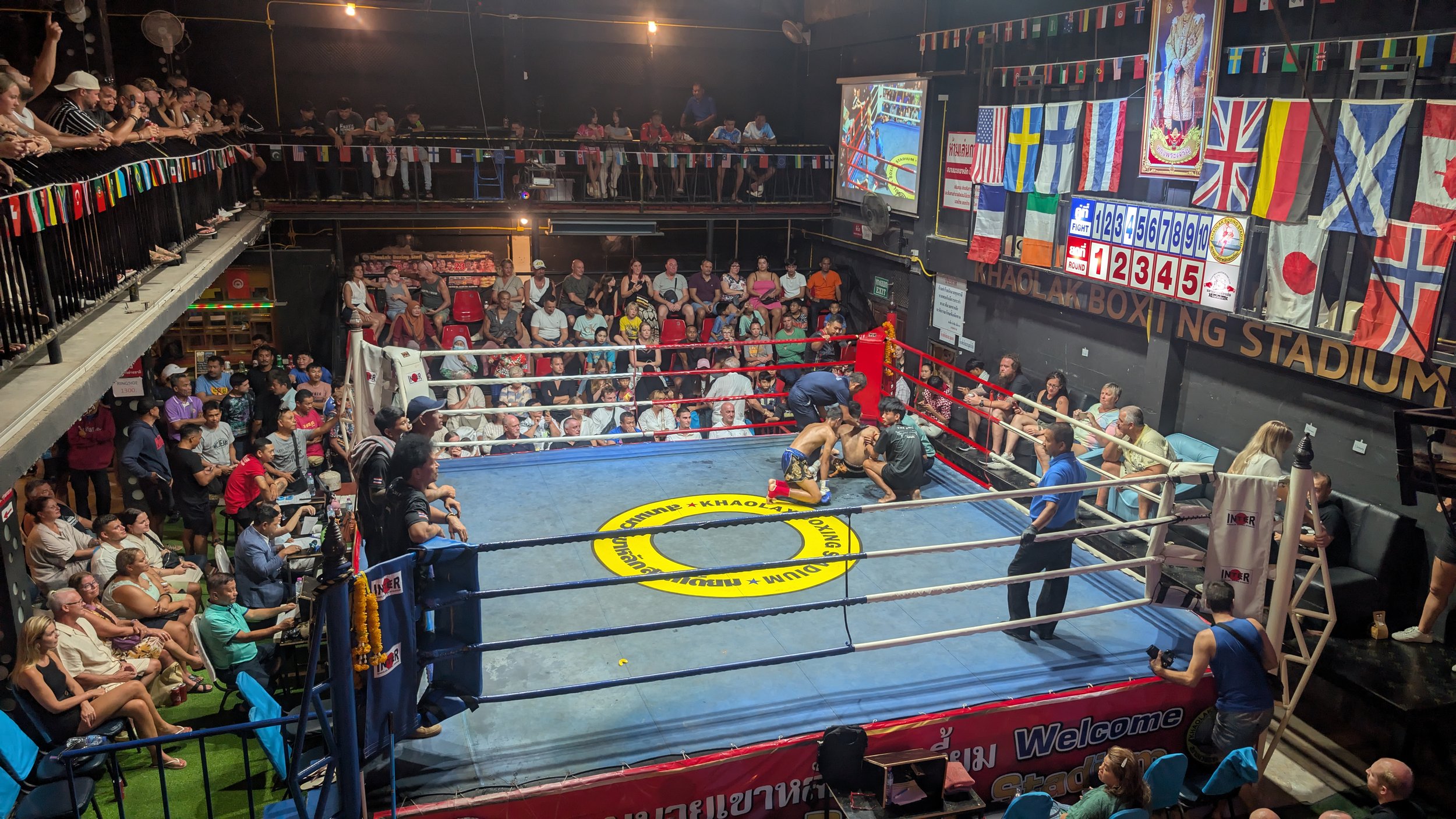
Somewhere between rounds, I learned that this place, serene on the surface, had once been swallowed by water. Years before, a tsunami had rushed in and taken hundreds of lives without warning. One man told me how the waves tore his two children from his hands. He spoke without drama, as though grief had burned away the need for embellishment. I had never heard pain spoken so plainly. We understood each other without explanation. Loss has its own language.
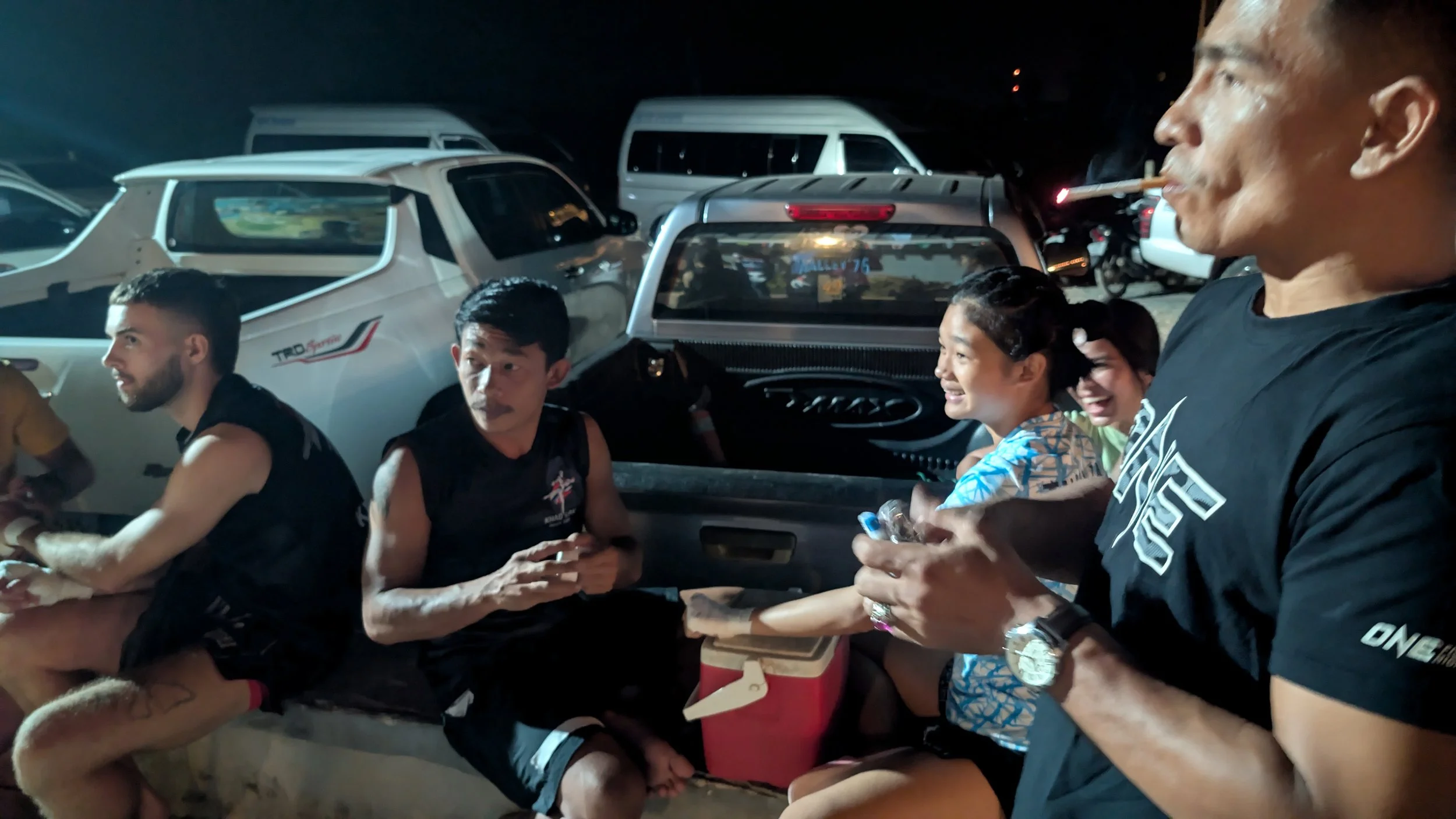
One night, after weeks of training, I watched my gym prepare for fights. My coach’s daughter—fourteen years old, and my friend Joe, a German in his late twenties, stood ready. If you have never trained to fight, you cannot know what it is to face another person intent on hurting you, or what it costs to quiet the body before the first strike. The air in Khao Lak that night was thick with heat, nerves, and something like reverence. It felt ancient. Necessary.
They both won.
And if there is one thing this journey taught me, it is this: there will always be something worth fighting.
The question is not whether the fight exists, but whether we are brave enough to choose the right one, and honest enough to know when the fight is with ourselves.